Firefly Tiller Stops – A Simple Component That Matters
It is often the simple things which have the biggest impact.
The Rondar Firefly requires tiller stops to prevent the tiller from contacting the deck or becoming trapped beneath the transom bar. Failure of the tiller stop will lead to damage and ultimately the failure of the tiller arm.
For team racers in particular, where large rudder angles are regularly used, the tiller stop becomes operationally critical. When it fails, loads are transferred directly into the tiller arm, often with expensive consequences.
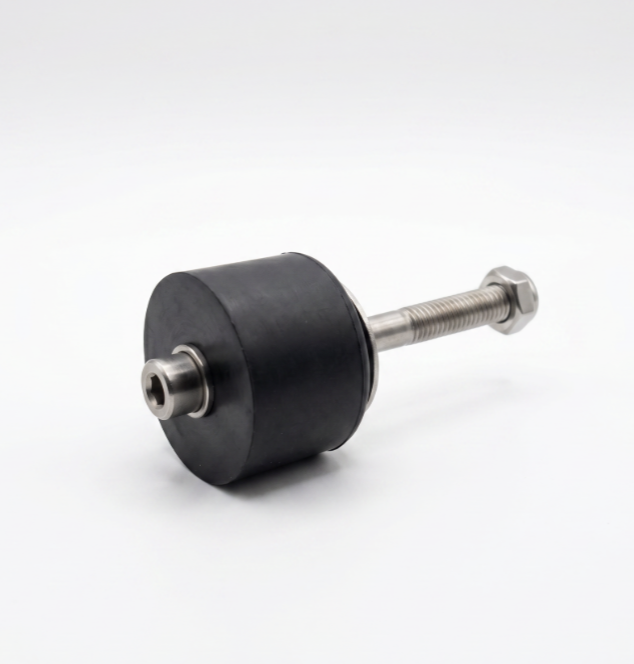
At first glance, the tiller stop is simple: a door stop, a bolt, a nut, and a couple of washers. In reality, there is more going on beneath the surface.
The Bolt
Most Rondar Fireflies left the yard fitted with an M5 pan head machine screw as the core of the tiller stop.
The pan head is effectively the largest standard head that will fit within the mainsheet track. However, the sloped profile means that over time the mainsheet traveller will wear the edge of the head. As this happens, the traveller can begin to catch and eventually jam.
More importantly, the M5 bolt itself does not tolerate repeated loading well. With sustained use, particularly in team racing, it will begin to bend. Once bent removal becomes difficult, often requiring cutting with a hacksaw or Dremel. If rushed, this can easily lead to damage to the transom bar.
There is also variation in positioning. Some stops are installed through pre-drilled holes in the track, others through the track end stops, and boats fitted with centreline U-bolts often sit somewhere between the two. This positioning directly affects available rudder movement.
A simple and effective improvement is to move to an M6 bolt, ideally with a socket (cheese) head. This provides a more robust stop and significantly improves durability; the cheese head will help prevent the traveller from jamming. While the M6 bolt can still fail over time, its performance is far better—particularly when paired with a well-maintained stop.
The Stop
The stop itself is the key component and but is the most likely to fail first.
Some boats were fitted with hollow stops at build. These are cheap and easy to source but tend to fail quickly. Once the stop collapses or splits, the bolt is exposed, and damage to the tiller arm can escalate rapidly.
Most boats have used solid rubber stops. These perform well, but are susceptible to perishing over time, especially due to UV exposure around the transom area. Other materials have been tried, including harder plastics and 3D printed alternatives, but solid rubber remains the most practical and cost-effective option—provided it is replaced periodically.
Black rubber stops can mark the tiller, but generally offer better durability and value. White stops are typically stiffer, perish more quickly, and are harder to source. As of early 2026, we have moved back towards black stops as the preferred option.
The Nut and Washers
There should not be much to say here—but these still matter.
Overtightening the nut will compress the stop unnecessarily and significantly accelerate its failure—particularly with harder materials such as white rubber.
Similarly, while penny washers help spread load, they can become problematic if the stop deteriorates. Once the stop begins to fail, the washer can introduce harder contact surfaces, increasing the risk of damage rather than reducing it.
Final Thoughts
This is a small and easily overlooked component, but one that plays a critical role in protecting the tiller arm and rudder stock; particularly on Rondar boats with Genesis stocks.
Regular inspection and simple upgrades can significantly extend the life of the tiller and prevent avoidable damage.
Available from the kSail Store
The Tiller Stop in complete form or the component parts are all available from the kSail store; if
Firefly Tiller Stop (Complete) | |
 | |
Components | |
| Solid Rubber Stop - Black | |
M6 x 70mm Socket Head Bolt | |
M6 Penny Washer | |
M6 Nyloc | |
M6 Plain Washer | |